From HSUPA to 5G: The Evolution of Mobile Uplink Technology
A technical walkthrough of how mobile uplink architecture evolved from HSUPA's 3.5G packet access through LTE to modern 5G NR, and what that progression means for practitioners today.
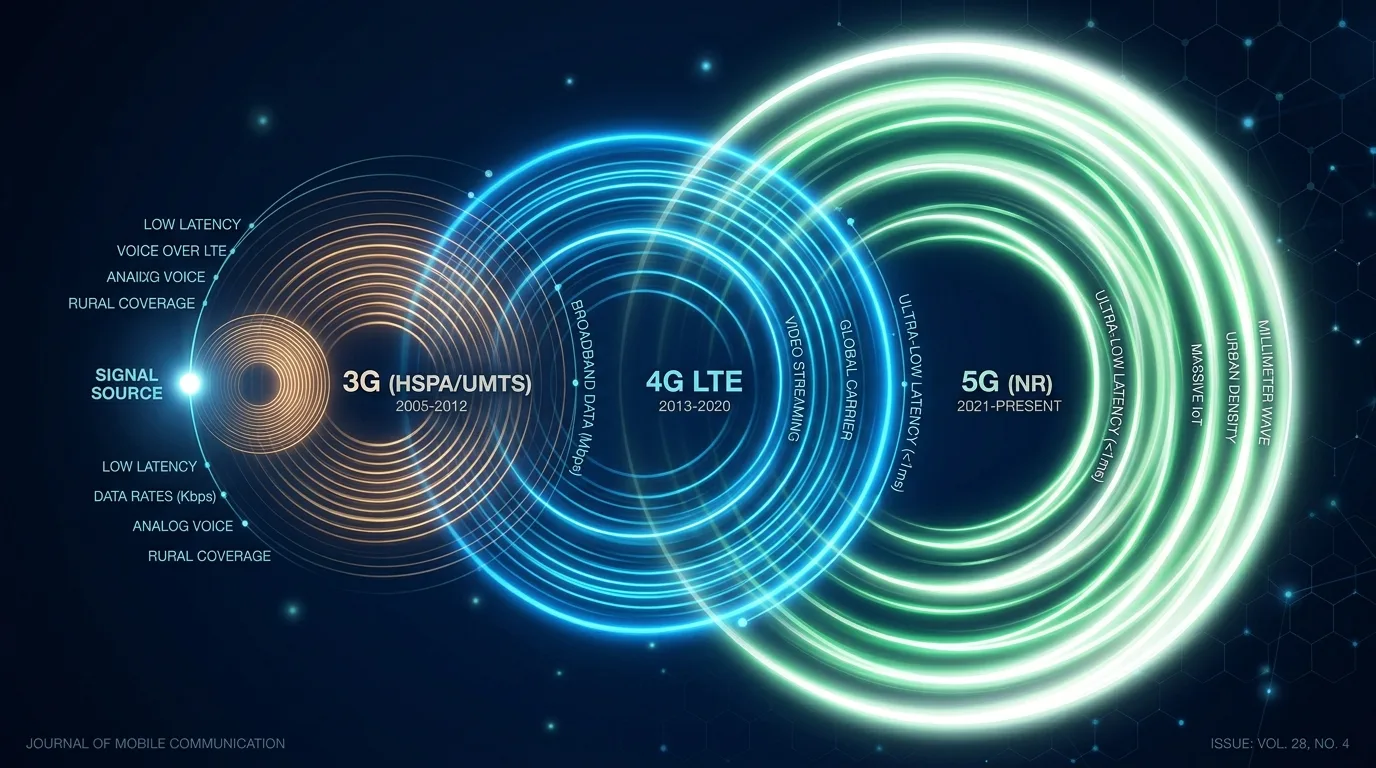
Mobile uplink performance has always lagged download throughput in cellular network design. When High-Speed Uplink Packet Access (HSUPA) arrived as 3GPP Release 6 in 2004, it addressed exactly this asymmetry in WCDMA networks. More than two decades later, the same fundamental problem drives 5G NR uplink enhancements, the mechanisms just operate at a different scale.
This article traces the architectural thread from HSUPA through LTE to 5G NR, with emphasis on how each generation solved the uplink bottleneck and what practitioners running mobile infrastructure or IoT deployments should understand about that lineage.
What HSUPA Actually Solved
Before HSUPA, WCDMA uplink used the Dedicated Channel (DCH) with relatively slow rate control. The Node B had limited visibility into per-UE buffer status, and scheduling decisions were made primarily by the RNC, introducing latency and inefficiency.
HSUPA, formally called Enhanced Dedicated Channel (E-DCH), moved scheduling intelligence down to the Node B. The key mechanisms were:
- E-DPCCH and E-DPDCH: Separate control and data channels on the uplink, allowing the UE to signal its buffer status and power headroom in real time.
- Node B-controlled scheduling: The base station could grant transmission resources within 2 ms or 10 ms TTIs, dramatically improving reaction time to changing radio conditions.
- Hybrid ARQ (HARQ) with soft combining: Retransmitted packets were combined with earlier attempts at the receiver, improving effective throughput without consuming additional spectrum.
- Multi-code transmission: Peak rates of 5.76 Mbps were achievable on devices supporting the highest category, versus the 384 kbps typical on DCH.
For devices like the Toshiba Portégé G810 and Sony Ericsson XPERIA X1, flagship hardware at the time hsupa.com covered them, these gains meant practical uplink speeds that made mobile multimedia sharing viable for the first time.
The HSPA+ Bridge
3GPP Release 7 extended HSPA with MIMO support and higher-order modulation (64QAM on downlink, 16QAM on uplink), marketed broadly as HSPA+. Release 8 added dual-carrier operation.
From an uplink perspective, the most significant Release 7 addition was 16QAM on E-DPDCH, lifting the theoretical uplink peak to 11.5 Mbps on Category 7/8 devices. More practically, continuous packet connectivity (CPC) introduced a discontinuous transmission mode that reduced interference and extended battery life, a direct enabler of always-on mobile data behavior that users now consider standard.
The HSPA+ era also saw carriers like AT&T and Vodafone deploy software upgrades to existing HSUPA base stations rather than full hardware replacement, demonstrating the architectural flexibility that 3GPP had designed into the E-DCH framework.
LTE: Rewriting the Uplink Stack
LTE (3GPP Release 8) replaced WCDMA entirely with OFDMA on the downlink and SC-FDMA on the uplink. The SC-FDMA choice was deliberate: it retains the low peak-to-average power ratio (PAPR) advantage of single-carrier waveforms, reducing UE power amplifier demands compared to straight OFDMA.
LTE uplink scheduling operates on a 1 ms subframe (TTI), eight times shorter than HSUPA's 8 ms practical scheduling interval in many deployments. The eNodeB handles all uplink scheduling decisions, a complete collapse of the split RNC/Node B model from HSUPA.
Key LTE uplink advances over HSUPA:
| Feature | HSUPA (Release 6) | LTE Release 8 |
|---|---|---|
| Peak uplink (theoretical) | 5.76 Mbps | 75 Mbps (2x2 MIMO) |
| Scheduling TTI | 2 ms / 10 ms | 1 ms |
| Waveform | WCDMA (spread spectrum) | SC-FDMA |
| HARQ processes | Up to 8 | Up to 8 |
| Scheduler location | Node B | eNodeB (no RNC split) |
LTE-Advanced (Release 10) added uplink carrier aggregation, allowing UEs to transmit on multiple component carriers simultaneously and pushing theoretical uplink peaks above 1 Gbps in lab conditions.
5G NR Uplink: Where the Architecture Stands Today
5G NR (New Radio, Release 15 and beyond) introduces flexible numerology through its subcarrier spacing options (15 kHz to 240 kHz), allowing the same spectrum to be configured for different latency and throughput targets. For uplink specifically, NR brings several advances that practitioners deploying private networks or cellular IoT should understand.
Uplink Waveform Flexibility
NR supports both CP-OFDMA and DFT-s-OFDM (the SC-FDMA successor) on the uplink. The choice is per-slot and per-UE. DFT-s-OFDM remains preferred for coverage-limited scenarios, edge devices and IoT endpoints, because of its PAPR advantage, while CP-OFDMA enables higher spectral efficiency when link budget is not the constraint.
Enhanced HARQ and Mini-Slots
NR introduces mini-slot scheduling (2 or 7 symbols versus a full 14-symbol slot), enabling sub-millisecond uplink transmissions. This directly benefits latency-sensitive applications, industrial automation, vehicle-to-infrastructure messaging, and remote monitoring, that were impossible on HSUPA's 10 ms TTI and impractical even on LTE's 1 ms TTI due to scheduling overhead.
Uplink Power Control Refinements
NR uplink power control inherits LTE's fractional path-loss compensation model but adds enhancements for massive MIMO scenarios. With base stations deploying 64 or more antenna elements, spatial multiplexing allows multiple UEs to transmit on the same time-frequency resource. The system manages inter-user interference through beamforming rather than orthogonal resource allocation alone.
5G Uplink in Private Networks
Private 5G NR deployments in manufacturing, logistics, and utilities frequently prioritize uplink performance in ways public networks do not. A camera-equipped autonomous robot uploading real-time video for edge inference has stricter uplink requirements than a smartphone user streaming Netflix. Network slicing and QoS frameworks in NR allow operators to carve dedicated uplink capacity for these use cases, a capability that HSUPA's single-bearer model could not approach.
Practical Implications for Network Planners
The throughput numbers across generations are well-known. Less discussed are the planning implications:
Coverage vs. capacity trade-offs persist. HSUPA's uplink improvement was partly a coverage improvement, HARQ soft combining and power control adjustments meant edge UEs could maintain usable uplink rates where DCH would have failed. NR DFT-s-OFDM serves the same purpose in 5G. When planning 5G deployments, uplink coverage budgets require separate modeling from downlink.
Backhaul and fronthaul have shifted. HSUPA's Node B scheduling required synchronization but kept baseband processing at the RNC. Modern 5G Centralized RAN (C-RAN) or Open RAN architectures pull baseband to a central unit, placing strict latency requirements on fronthaul. Network planners transitioning from 3G infrastructure need to account for this architectural inversion.
IoT uplink dominates new use cases. NB-IoT and LTE-M remain widely deployed for low-power applications. 5G RedCap (Reduced Capability, Release 17) targets mid-tier IoT devices that need more than NB-IoT can offer but do not justify full NR complexity. Understanding uplink behavior in these reduced-capability modes is increasingly central to IoT platform selection.
Conclusion
HSUPA established that uplink scheduling, HARQ, and close coupling between the UE and base station are the right architectural primitives for high-performance mobile uplink. Each subsequent generation, HSPA+, LTE, LTE-Advanced, and 5G NR, has refined those same primitives rather than discarding them. Practitioners who understand why HSUPA worked the way it did will find the 5G NR uplink design considerably more legible than those approaching it cold.
Related reading on hsupa.com: