Guide to 3G Mobile Broadband Hardware: Routers, Data Cards, and What They Got Right
A practitioner's reference on the HSUPA-era hardware ecosystem, USB dongles, ExpressCard modems, and mobile routers, and how those design decisions informed modern cellular modem architecture.
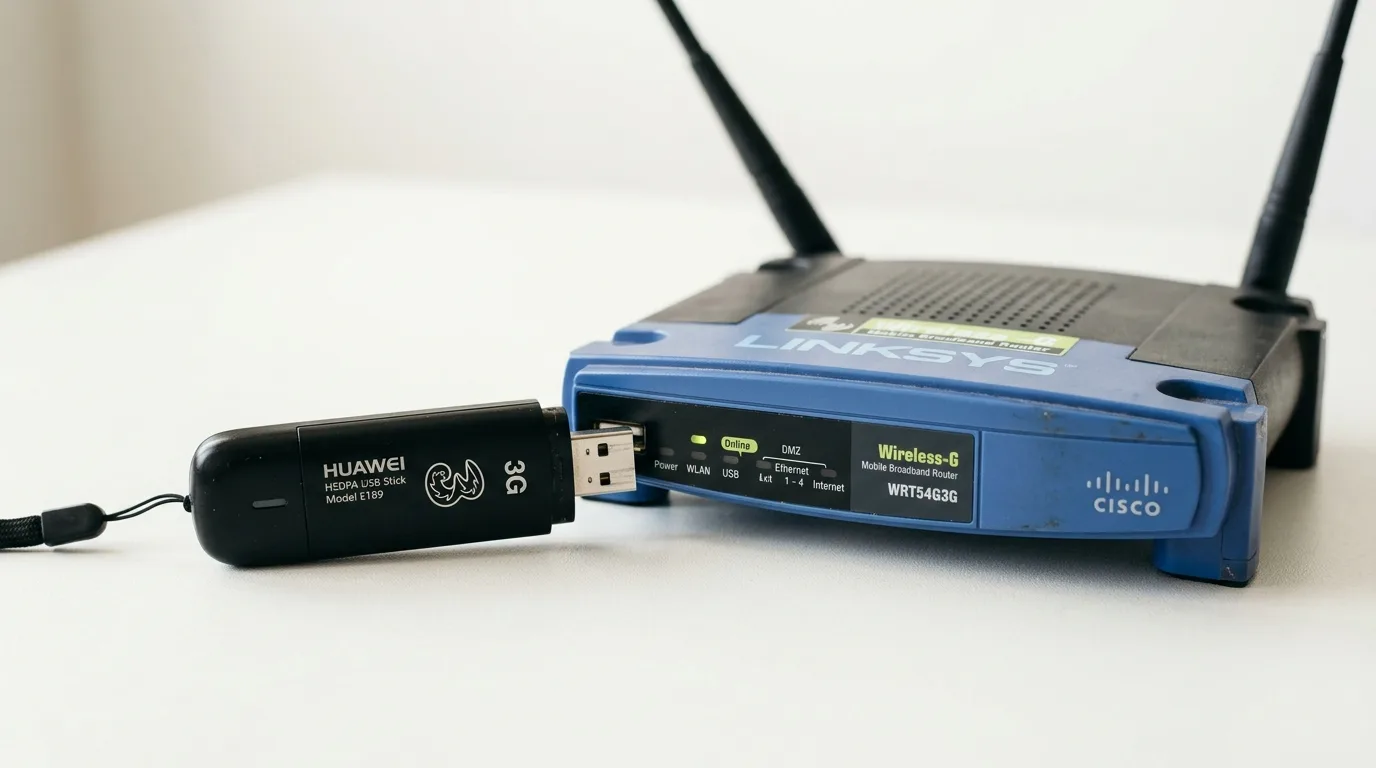
The period from roughly 2007 to 2012 produced a specific category of hardware: devices built explicitly to expose HSUPA's uplink capability to end users and enterprises. USB modems, ExpressCard data cards, embedded mobile routers, and HSUPA-capable smartphones all shared the same fundamental requirement, translating the physical layer gains of E-DCH into usable connectivity for applications.
Understanding how that hardware was designed, what constraints it operated under, and where it succeeded and failed provides useful context for evaluating modern cellular IoT modules, industrial routers, and embedded 5G solutions that descend from the same lineage.
The Form Factor Landscape
USB Modems (Dongles)
The USB modem was the dominant consumer form factor for HSUPA access. Devices from Huawei, Sierra Wireless, ZTE, and Option N.V. plugged directly into a laptop's USB port and presented a virtual serial interface or NDIS interface to the host operating system.
Key specifications that differentiated HSUPA dongles from earlier HSDPA-only models:
- HSUPA category support: Cat 5 devices supported 2 Mbps uplink; Cat 6 reached 5.76 Mbps. Many early "HSPA" dongles supported only HSDPA downlink with W-CDMA uplink, a distinction retailers rarely highlighted.
- Antenna design: Internal helical or PIFA antennas were adequate for urban coverage but limited in fringe areas. Some enterprise-grade dongles added external antenna connectors, a feature that reappeared as a standard requirement in modern LTE and 5G modules.
- Driver architecture: Windows-first driver stacks were the norm. Linux support ranged from community-maintained to nonexistent, a friction point that pushed enterprises toward hardware with more portable AT command interfaces.
The Sierra Wireless AirCard 875U and Huawei E220 were representative of the category. Both shipped with carrier-branded software that provided signal monitoring and connection management, the direct predecessor to modern modem management APIs.
ExpressCard and PC Card Modems
Enterprise laptops of the era often included ExpressCard/34 or PC Card slots, and cellular modem manufacturers targeted these for better thermal performance and persistent connectivity. ExpressCard modems avoided the USB enumeration overhead and generally presented more stable interfaces for enterprise VPN and always-on applications.
The Sierra Wireless AirCard 880E and Novatel Wireless EU870D were common in this category. Both supported external antenna connection, and several carriers offered them as primary broadband solutions for locations with marginal 3G coverage where the gain from an external antenna made the difference between a usable connection and none.
Mobile Routers and MiFi Devices
The MiFi concept, a battery-powered device that terminates the cellular connection and presents a local Wi-Fi access point, emerged during the HSUPA era and addressed a fundamental limitation of USB dongles: they served one host at a time.
Novatel Wireless's MiFi 2200 (2009) became the reference design for this category. It combined an HSPA modem, a Wi-Fi 802.11b/g access point, and a battery into a credit-card-sized device. From a network perspective, the MiFi introduced NAT between the cellular bearer and connected devices, which had practical implications for applications requiring end-to-end addressing, a problem that cellular IoT architects still navigate today when distinguishing between devices behind carrier-grade NAT and those with direct IP assignment.
Integrated Devices: HSUPA Smartphones and Laptops
Smartphones incorporating HSUPA modems represented a different integration model, the radio as a system component rather than an accessory. The Sony Ericsson XPERIA X1 and Toshiba Portégé G810 (the latter embedding HSUPA alongside a full laptop platform) demonstrated that integrating uplink-capable 3G into primary computing devices was feasible at the power and thermal budgets available.
The Portégé G810 in particular illustrated the enterprise mobile broadband use case: a professional device where cellular connectivity was persistent rather than supplemental, relevant to field service, public safety, and mobile workforce deployments. That positioning maps directly to modern enterprise laptops with embedded LTE/5G and always-on connectivity management.
Modem Chipsets and AT Command Interfaces
Behind all of these form factors sat a small number of modem chipset families. Qualcomm's MDM series, Ericsson Mobile Platforms (later acquired and folded into ST-Ericsson and eventually Intel), and Option's GlobeSurfer chipsets powered most of the market.
The AT command interface, originally standardized for dial-up modems and extended through Hayes-compatible expansions, remained the primary control plane for HSUPA modems. Carrier-specific extensions handled:
- Network selection and band locking
- Signal quality reporting (RSSI, RSCP, Ec/No for WCDMA)
- USSD and SMS passthrough
- Data call establishment via +CGDCONT and ATD99**1#
These same AT commands, with additions for LTE (3GPP TS 27.007 and TS 27.005), remain the standard interface for cellular modules in IoT deployments today. Engineers working with Quectel, u-blox, or Sierra Wireless modules on LTE-M or 5G RedCap projects are using a control interface whose core grammar was set during the HSUPA era.
Antenna Design Constraints
HSUPA operated in licensed spectrum bands, typically 850 MHz, 900 MHz, 1900 MHz, and 2100 MHz depending on carrier and region. Antenna design for USB dongle form factors required fitting resonant structures for multiple bands into enclosures with minimal ground plane.
The dominant approaches:
PIFA (Planar Inverted-F Antenna): Low profile, ground-plane dependent, suitable for integration into flat enclosures. Most USB dongles used PIFA variants tuned for primary operating bands.
Helical antennas: Volumetrically efficient, less ground-plane dependent, used in earlier and smaller form factors. Bandwidth was narrower, which became a constraint as devices needed to cover more bands.
External connector options: SMA or TS-9 connectors allowed connection to external directional or high-gain antennas. This feature was critical for fixed wireless installations where the modem served as a CPE substitute. The same design consideration applies directly to modern industrial cellular routers where external antenna support is often a procurement requirement.
Power Management and Thermal Considerations
HSUPA transmission at peak rates (5.76 Mbps) drove significant power consumption in UE devices. Maximum UE transmit power in WCDMA is 24 dBm (power class 3, the most common for data devices), and sustained uplink transmission approached this limit under poor coverage conditions.
USB dongle thermal performance was often constrained by the USB enclosure's surface area and the host system's USB power delivery (500 mA at 5V = 2.5W maximum from a standard port). In practice, modems regulated transmission power and rate based on available power budget, meaning a modem running from a low-power USB hub performed differently than one connected to a direct host port.
This power-thermal interaction has a direct parallel in modern 5G NR modules. Sub-6 GHz modules in USB or M.2 form factors face similar constraints, and mmWave modules in particular require careful thermal design because their power amplifier efficiency at 28 GHz or 39 GHz is significantly lower than at 2.1 GHz.
What This Hardware Got Right
Several design decisions from the HSUPA hardware era have proven durable:
Separating the cellular connection from the application host. The MiFi model, modem as a network edge device rather than a host peripheral, aligns with how industrial IoT deployments are increasingly architected. Cellular routers with local processing capability (edge compute + connectivity) are a direct evolution.
External antenna connectivity. Devices that shipped with antenna connectors consistently delivered better performance in enterprise and fixed deployments. Modern M.2 cellular modules almost universally include antenna connectors as a result.
AT command standardization. The decision to standardize on extensible AT command interfaces rather than proprietary binary protocols meant that software stacks developed for HSUPA modems could be adapted for HSPA+, LTE, and now 5G with incremental changes rather than full rewrites.
Band and operator flexibility. Unlocked HSUPA devices that supported multiple frequency bands set the expectation for multi-band cellular hardware that now defines industrial IoT module specifications.
Conclusion
The 3G mobile broadband hardware ecosystem was not just a historical footnote, it established form factors, interface standards, and design trade-offs that define the cellular hardware landscape today. Engineers selecting cellular modules for IoT platforms, industrial routers for private network deployments, or embedded connectivity solutions for mobile computing will find that many of the questions they are asking, antenna design, power budget, AT command interface, NAT behavior, were first worked through on HSUPA-era hardware.
Related reading on hsupa.com: